Benrus
Benrus Dial-O-Rama
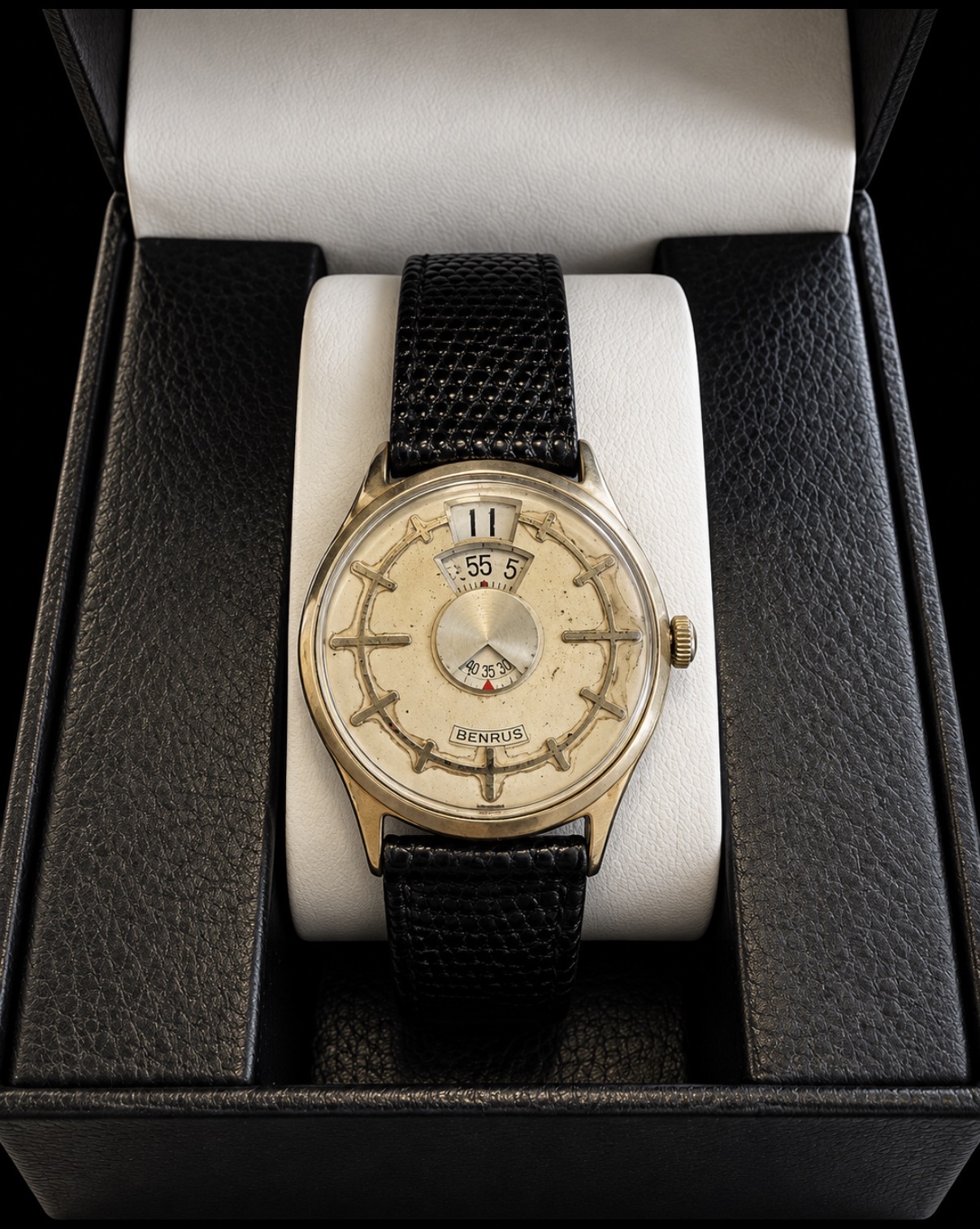
A circa-1957 Benrus Dial-O-Rama
- Movement
- Benrus FG 25, manual wind, 17 jewels, based on FHF 72
- Current Market Value
- $800
- Year
- c. 1957
- Case
- Gold-tone case with stainless steel back
- Size
- 33 mm wide x 40 mm lug-to-lug mm
- Condition
- Excellent
- Gender
- Men / Unisex
- Acquired
- 2026
Condition
Restored and serviced vintage condition.
Why I bought it
This is exactly the kind of early direct-read watch that interests me. It predates the explosion of mechanical digital watches in the 1970s and, unlike many watches that simply replace conventional hands with rotating discs, the Dial-O-Rama uses a genuine jumping-hour mechanism. I also like the unusual combination of three different moving displays: jumping hours, rotating minutes and the central "mystery seconds" style indication. It is mechanically and visually different from most of the later jumping-hour watches in my collection.
The Benrus Dial-O-Rama is an unusual American-market mechanical jumping-hour watch dating from approximately 1957, well before mechanical digital watches became fashionable during the 1970s.
Rather than using conventional hour and minute hands, the Dial-O-Rama divides the display into several moving elements.
The hour appears through an aperture at 12 o'clock and changes instantaneously at the top of each hour. Below it, a rotating disc displays the minutes. At the center of the dial is another rotating element that provides a "mystery seconds" style indication, giving the watch a particularly unusual appearance even among early direct-read watches.
Inside is the Benrus FG 25, a 17-jewel manually wound Swiss movement based on the FHF 72 family and modified for the Dial-O-Rama display.
The dial is also distinctive. A raised outer structure surrounds the otherwise relatively open dial, while the numerical displays are concentrated vertically through its center. The result looks quite different from the horizontally arranged hour-and-minute discs that became common during the 1970s.
The case measures approximately 33 mm across without the crown and 40 mm from lug to lug. The exact construction of the gold-tone case has not yet been confirmed. The caseback is marked BENRUS, Stainless Steel Back, Waterproof, Shock-Absorbing and Dustproof, together with U.S. Patent 2,302,340 and case number 246009. The patent relates to waterproof watch-case construction and should not be used to date the watch itself.
This example has been fully serviced according to the seller and comes with a six-month service warranty. It has also received a new NOS replacement crystal and is fitted with a NOS Speidel U.S.A. leather strap. The dial shows some light blemishing consistent with its age.
The Dial-O-Rama is particularly interesting within my collection because it demonstrates that the fascination with mechanical digital time displays did not begin with the familiar 1970s jumping-hour watches. Here was Benrus experimenting with a true jumping hour, rotating minutes and an unconventional seconds indication roughly fifteen years earlier.
From Instagram
⭐ From My Collection
Meet my latest purchase, a Benrus Dial-O-Rama from around 1957.
I've said before that a direct-read watch doesn't necessarily need to be from the 1970s to catch my attention. Actually, the earlier ones are often more interesting to me.
And this one really is interesting.
The hour jumps in the window at 12, the minutes rotate below it, and in the center there's this strange "mystery seconds" style display.
Inside is a 17-jewel Benrus FG 25 manual-wind movement, based on the FHF 72.
So this isn't just a watch that looks mechanical-digital. Benrus was playing with a true jumping-hour display roughly 15 years before these watches became so popular in the 1970s.
It was recently serviced and comes with a 6-month service warranty, which is always nice when buying a watch that is almost 70 years old.
#Benrus #DialORama #JumpingHour #JumpHour #VintageWatches