9 August 2026
The Pin-Lever Movement
The inexpensive movement behind many of the jumping hours we collect today.
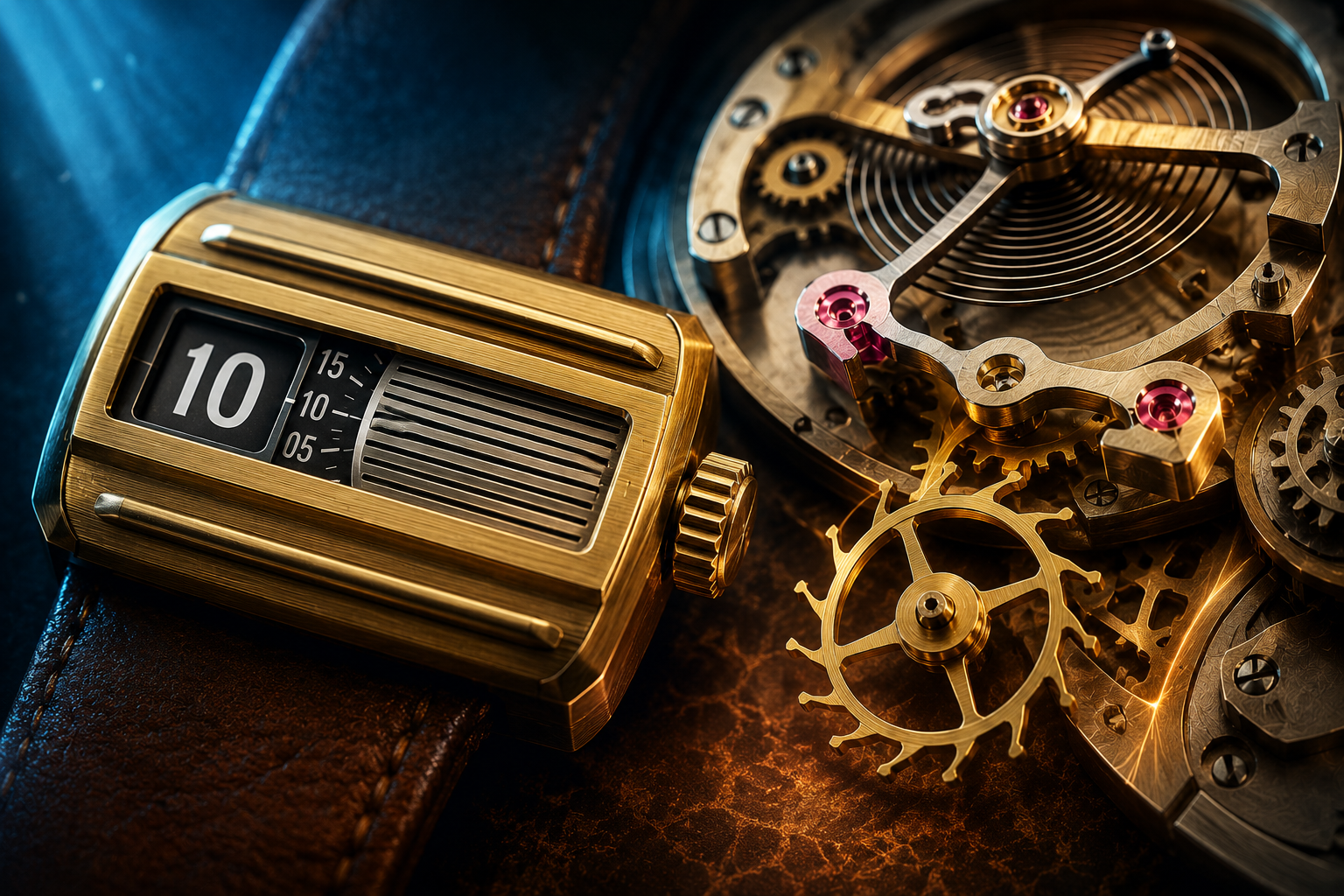
If you, like me, spend enough time hunting affordable Swiss jumping hour watches from the 1970s, sooner than later you will encounter a pin-lever movement.
I certainly have. Many of the inexpensive digital-display watches from this period used them, which makes the pin-lever an important part of the story of the jumping hour revival of the 1970s. The British Museum even preserves a Swiss digital wristwatch dating from 1972 to 1978 with a pin-pallet escapement, so this wasn't limited to obscure collector lore.
The idea, however, was already more than a century old.
In 1834, Swiss clockmaker L. Peron developed a pin-anchor escapement. Georges-Frédéric Roskopf took that idea further in 1867 when developing the inexpensive watch that became associated with his name. His goal was straightforward: make a mechanical watch that could be manufactured cheaply enough for ordinary people to afford. The Science Museum describes Roskopf's watch as the first satisfactory cheap watch and notes that the design was copied extensively in Switzerland.
That philosophy fits remarkably well with the jumping hour watches of a century later. During the 1970s, manufacturers could combine adventurous cases and mechanical digital displays with inexpensive movements and still produce relatively affordable watches. For the smaller Swiss brands whose jump hours I collect, the pin-lever was a very practical solution.
Its long career eventually came to an end for a fairly obvious reason: quartz.
By the late 1970s and into the 1980s, quartz could provide far greater accuracy at very low cost. The Seiko Museum notes that pin-lever watches virtually disappeared as cheaper quartz watches became popular. The Swiss lever wasn't really the movement that "replaced" the pin-lever at this point. It had already existed alongside it, in better-quality mechanical watches. Quartz simply took over the inexpensive mass-market role that pin-lever movements had filled so successfully.
So what is actually different?
Both are lever escapements, but their construction is not identical.
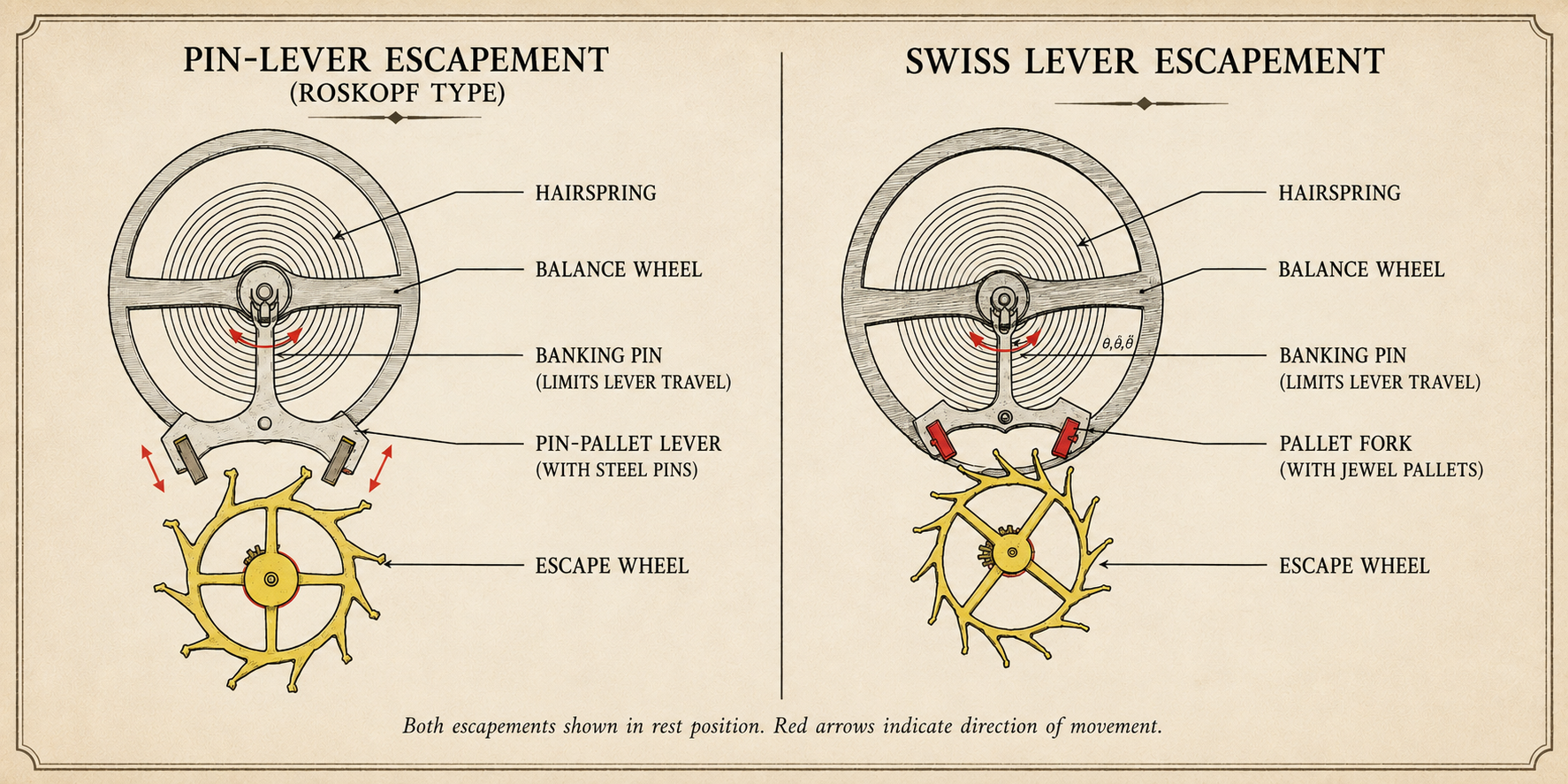
In a Swiss lever escapement, the escape wheel alternately locks against two shaped jewel pallets mounted in a pivoting pallet fork. As the escapement unlocks, impulse is transmitted through the pallet system and the fork to the roller jewel attached to the balance. The familiar Swiss club-tooth form evolved from Thomas Mudge's detached lever escapement of around 1756 and became dominant because its geometry reduced wear and allowed accurate adjustment of the pallet stones.
A Roskopf-type pin-lever simplifies that system. Instead of shaped jewel pallets, hardened steel pins mounted on the lever interact with a differently shaped escape wheel. British Museum examples also show the characteristic long lever, steel pallet pins and a separate impulse finger. These choices made the escapement cheaper to manufacture, but with more wear and less potential precision than a good jeweled Swiss lever.
There is also an interesting ancestor worth mentioning. Around 1715, George Graham developed the deadbeat escapement for precision pendulum clocks. Thomas Mudge had trained under Graham and later adapted ideas from the deadbeat principle when creating his detached lever escapement for watches. Mudge inserted a lever between the escape wheel and balance, reducing the direct interaction and friction that made the clock escapement unsuitable for a portable watch. That development eventually led to the Swiss lever we know today.
There are many other escapements in horological history, from the verge and cylinder to the marine chronometer's detent and, much later, George Daniels' co-axial. But for the watches most of us encounter, the comparison between pin-lever and Swiss lever is the important one.
I don't consider a pin-lever movement a sign of a bad watch. It tells me what the watch was designed to be. These weren't meant to compete with high-end Swiss movements. They were designed to be inexpensive, functional mechanical watches, and they helped put some wonderfully eccentric jumping hours onto people's wrists.
More than fifty years later, that's precisely why I find them interesting.
Sources:
Older comments
- GNGuy NevoAuthor
We all heard the term pin-lever, but many of us don't know what it actually means. I dived in to bring you some information. Let's discuss!
9 August 2026 - Marcus Bellini
Question: does the pin-pallet actually wear faster than a jeweled lever, or is that a myth? Would love a follow-up on longevity.
9 August 2026Hugo Lefèvre@Marcus Good question. From what I've seen, the steel pin on the pallet does wear, but the low beat rate means it takes decades. Not a myth, just slower than people assume.
9 August 2026 - LHLars Holm
In Germany we call these 'Roskopf-Uhr' with genuine affection. Working-class horology. Thank you for giving them a serious write-up.
9 August 2026 - Idris Mensah
Fascinating read. The pin-lever's reputation as 'cheap' undersells the ingenuity of Roskopf's simplification — making a serviceable escapement from stamped parts is its own kind of genius.
9 August 2026Mateo Ferraro@Idris Well put. Ingenuity under constraint is its own art form.
9 August 2026 - FAFrançois Aubert
A lovely counterpoint to the usual 'grail' discourse. The pin-lever is horology without ego.
9 August 2026Tomás Beltrán@François Thank you for your words!
9 August 2026 - Dominic Reyes
I have my grandfather's pin-lever Tissot from the 1950s. Still runs. There's something humbling about a 'lesser' movement outlasting flashier contemporaries.
9 August 2026AVAndrei Volkov@Dominic That's the real test, isn't it? Sixty years and still ticking. The flashier pieces are sitting in drawers.
9 August 2026 - CWCaleb Whitman
The pin-lever taught me more about escapements than any textbook. When you strip away the jewels and polish, the geometry becomes visible. Great article.
9 August 2026WAWilhelm Adler@Caleb Facts!
9 August 2026 - Étienne Roy
Never thought I'd find pin-levers charming, but this piece made me reconsider. Sometimes the modest mechanism tells the richest story.
9 August 2026 - JBJonas Berg
The honesty of a pin-lever is refreshing. No pretense, no decoration — just the mechanism doing its job. Not every watch needs to be a Patek.
9 August 2026