15 August 2026
They Exist(ed): Digital Before Electronics
How 19th-century challenge keeps haunting watchmakers.
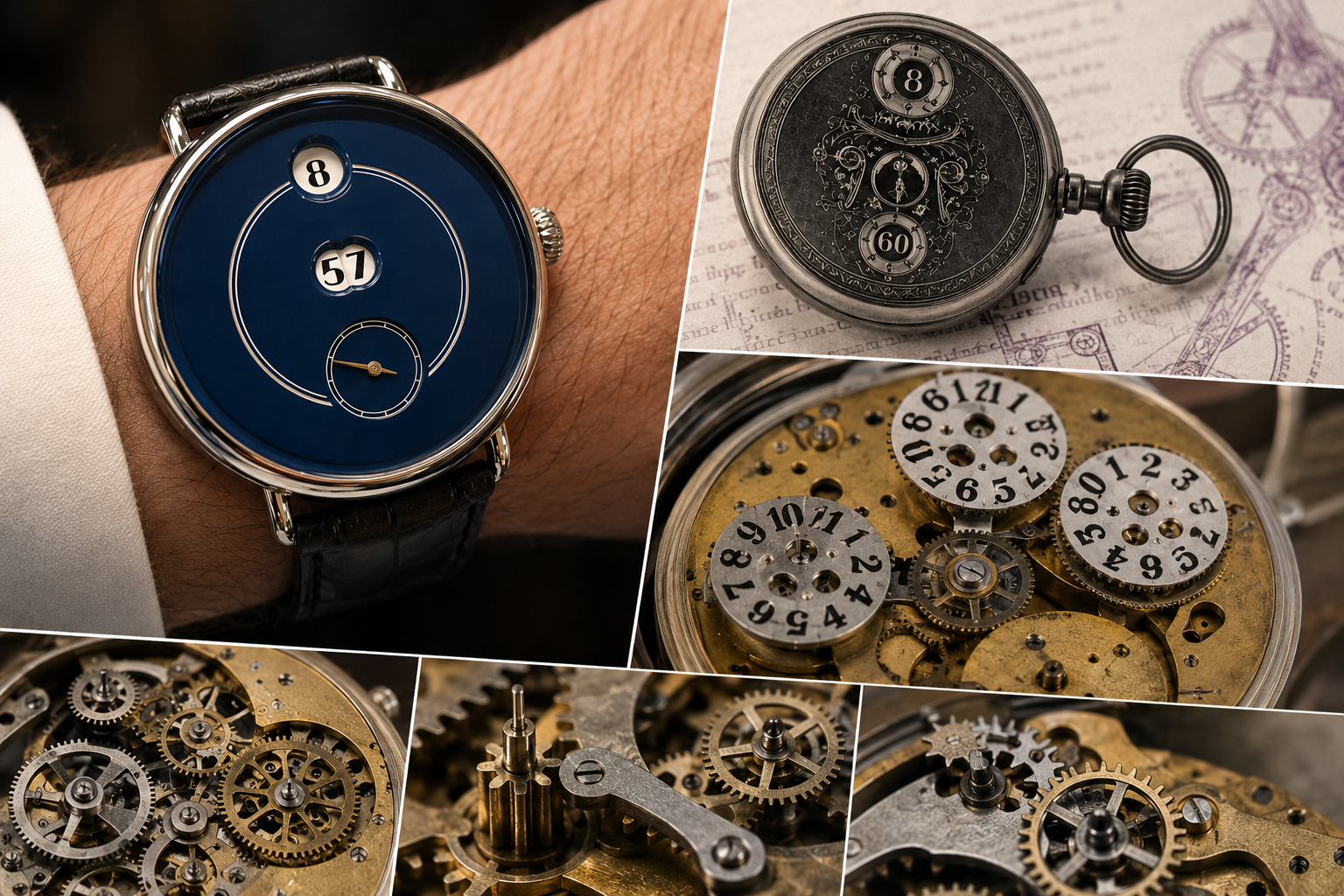
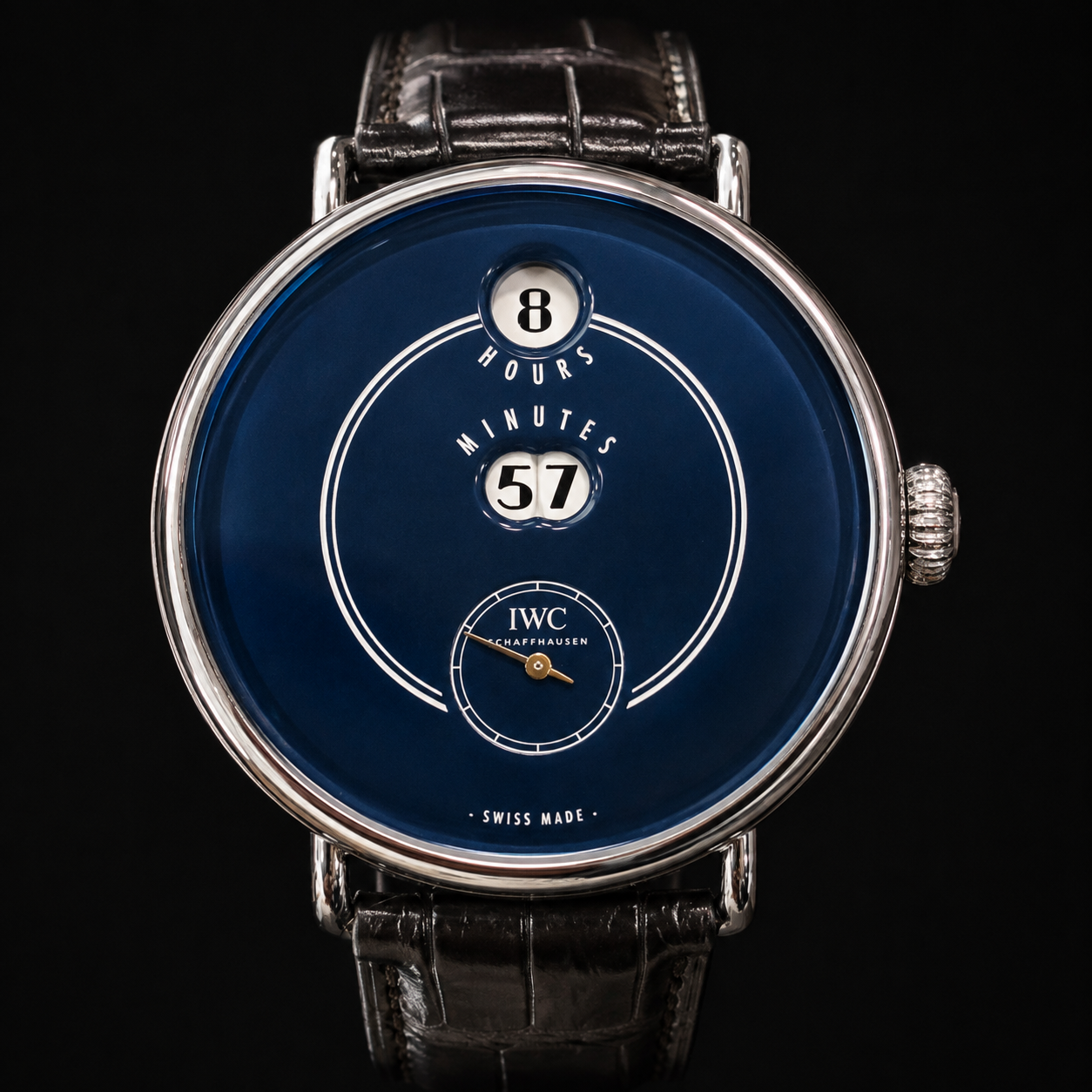
In 2018, IWC celebrated its 150th anniversary with an unusual watch: the Tribute to Pallweber Edition “150 Years”. At first glance, it looks almost modern. Instead of conventional hour and minute hands, the time appears through windows: one number for the hour and two for the minutes.
That first glance must have been very different 130 years ago when Josef Pallweber, a watchmaker working in Salzburg, presented his invention: a mechanism for a watch that is completely digital - it shows the hour and the minute in numbers, instead of on a dial. The system used three rotating discs: one for the hours, one for the tens of minutes and another for the individual minutes. Pallweber's American patent describes this arrangement, with the minute disc advancing once every minute, the tens disc every ten minutes and the hour disc once an hour. The first watchmaker to adopt this revolutionary mechanism was IWC that began making watches based on Pallweber's system in 1884.
Around 20,000 were eventually made in Schaffhausen before production ended in 1890. However, convincing numbers to jump brings about quite a mechanical challenge. A normal watch movement turns its wheels continuously. A digital display needs the numbers to remain still and then suddenly move to the next position.
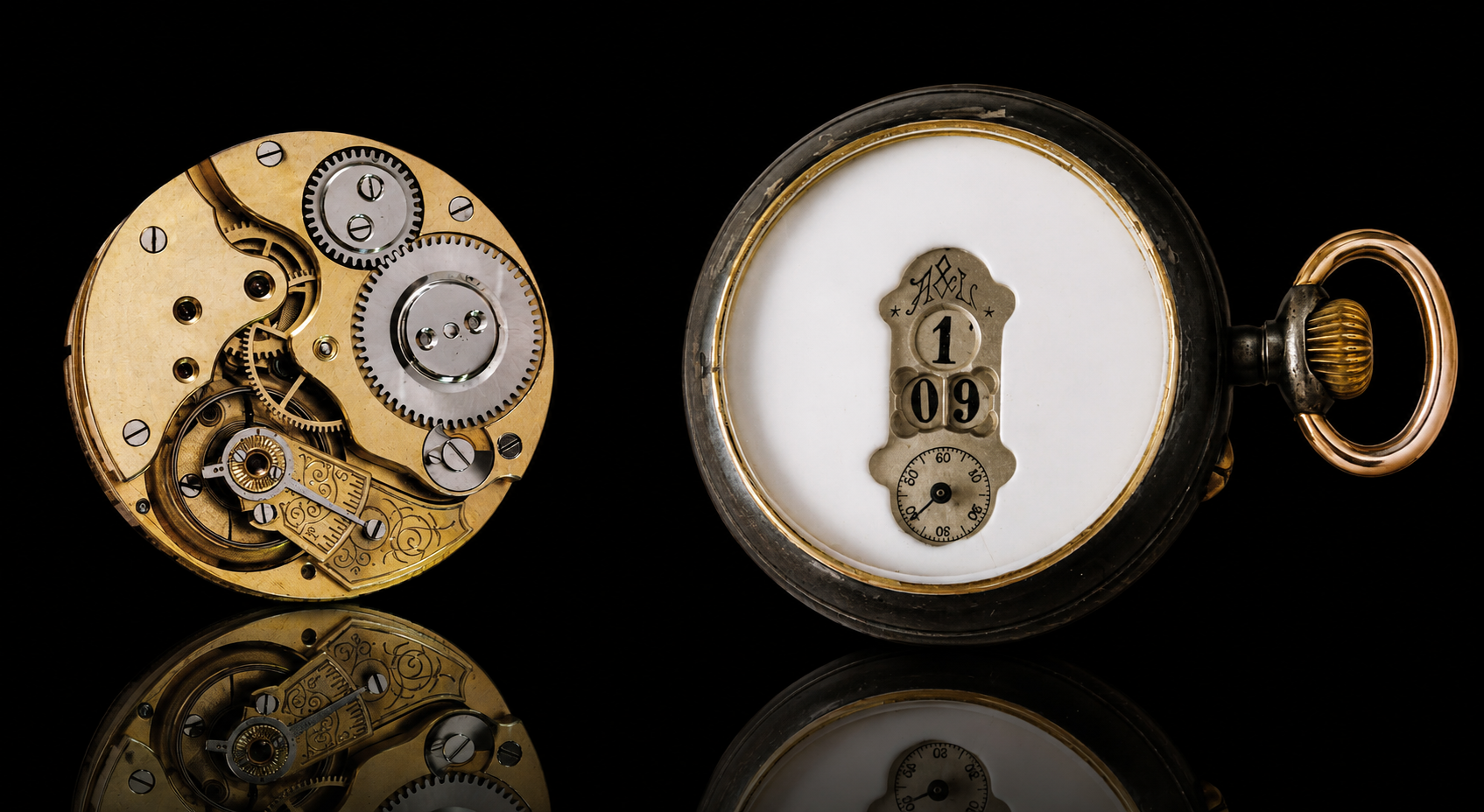
An article by Joseph Flores in Horlogerie Ancienne examines several surviving jumping-display pocket watches from roughly this period and shows that watchmakers found different solutions to the same problem. One uses a small spring that is armed and released at regular intervals. Another relies on interrupted gearing. The most interesting example has a 50-tooth wheel that initially seems incompatible with the required gear ratio. Looking closer reveals the trick. Some of the teeth are effectively bypassed and one leaf of the driving pinion is deliberately cut away. At a specific point in its rotation, this unusual geometry allows the display wheel to advance suddenly. Something that might look like damage is actually part of the mechanism. This also illustrates one of the difficulties with these early watches.
Moving relatively large discs instantaneously requires energy. IWC acknowledges that the original Pallweber watches suffered from a relatively limited power reserve because of the energy needed to advance their displays. More than a century later, IWC approached the same problem differently. The 2018 Tribute uses the hand-wound calibre 94200. Instead of simply reproducing the old mechanism, IWC gave the jumping display a separate wheel train and its own barrel. Every 60 seconds the mechanism releases it briefly to advance the single-minute disc. Every ten minutes the tens disc advances, and once an hour the hour display jumps. The main timekeeping train therefore doesn't have to provide the sudden bursts of energy required by the display.
That is what I find most interesting about the Pallweber rebirth story. The 2018 IWC is not a retro watch. It connects beautifully with a legacy of a mechanical challenge that watchmakers have been struggling with since the 1880s and solves it, without sacrificing the tradition and history it is built on.
Older comments
 Guy NevoAuthor
I didn't know IWC was making Jump Hour pocket watches as early as 1884, did you?
15 August 2026- Lucía Fernández
20.000 unidades en Schaffhausen... me pregunto cuántas sobreviven hoy en estado de funcionamiento. Una pieza de historia increíble.
15 August 2026 - Hannah Olszewski
The power reserve problem is such a classic example of why mechanical digital is harder than it looks. Great article.
15 August 2026 - Diego Marín
Me encanta cómo conectas el IWC de 2018 con su legado del siglo XIX. Esa parte del barrilete independiente es brillante ingeniería.
15 August 2026 - Eleanor Pryce
I had no idea the Pallweber system went back to the 1880s. Always assumed jumping hours were a 1970s invention. Thank you for the history lesson.
15 August 2026 - Marcus Whitfield
Fascinating read. The detail about the 50-tooth wheel with the deliberately cut pinion is the kind of thing that makes vintage horology so rewarding to study.
15 August 2026 - Claire Dubois
Beautifully written. The line about it not being a retro watch but a continuation of a 140-year-old challenge really stuck with me.
17 August 2026 - Hiroshi Tanaka
That interrupted gearing sounds almost like a bug until you understand the geometry. Would love to see a slow-motion video of that 50-tooth wheel in action.
17 August 2026 - Diego Fuentes
El enfoque de IWC con un barrilete independiente para la pantalla es brillante. Resuelve el problema de la reserva de marcha sin comprometer el tren principal.
17 August 2026 - Elena Rossi
I had no idea the original Pallwebers had such a short production run. 20,000 sounds like a lot until you remember they were made over just six years.
17 August 2026 - Marcus Wellman
Fascinating piece. The detail about the cut-away pinion leaf is the kind of thing you never read elsewhere — thanks for digging into Horlogerie Ancienne.
17 August 2026